
Common dolphins in Gansbaai, South Africa have streamlined bodies built for efficient swimming, with a prominent beak, or rostrum, and a dorsal fin positioned around the middle of the back. Adults are generally around 1.8 to 2.5 metres long, although size can vary between populations and regions.
One of their most distinctive features is their beautiful colour pattern. Common dolphins are often described as having an “hourglass” or “criss-cross” pattern along each side of the body. Yellowish or tan colouring towards the front combines with paler grey towards the rear, contrasting with the darker back and lighter underside.
Like other dolphins, common dolphins have numerous conical teeth designed for gripping slippery prey rather than chewing it. Fish and squid are generally swallowed whole.
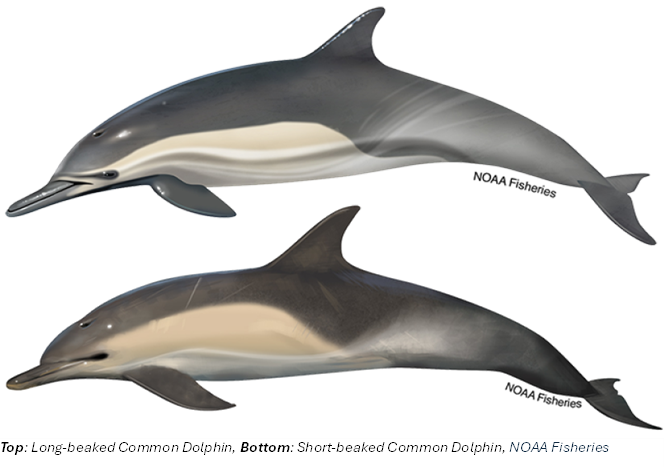
The length and shape of the beak was historically one of the characteristics used to distinguish long-beaked and short-beaked forms of the common dolphin.
Long-Beaked and Short-Beaked Common Dolphins
Older marine biology books and websites often describe two separate species: the Long-beaked Common Dolphin (Delphinus capensis) and the Short-beaked Common Dolphin (Delphinus delphis).
However, common dolphin taxonomy has changed as scientists have gained a better understanding of the relationships between different populations. The long-beaked form historically called Delphinus capensis, including the form found in South African waters, is now included within the Common Dolphin, Delphinus delphis, rather than being recognised as a separate species.
You may therefore still encounter the names Long-beaked Common Dolphin and Short-beaked Common Dolphin in older publications and identification guides. In Gansbaai, the dolphins historically described as Long-beaked Common Dolphins are the form relevant to our local waters.
Social Life and Behaviour
Common dolphins are highly social animals and can be encountered in groups of very different sizes. Although smaller groups are common, they can also gather in much larger aggregations when feeding conditions are favourable
Groups can contain hundreds or even thousands of dolphins. These spectacular gatherings are sometimes referred to as superpods.
Within these large aggregations, dolphins may form smaller social groups that travel, feed and interact together. Seeing large numbers of common dolphins moving through the water can be an extraordinary sight, with individuals often surfacing together and travelling rapidly towards feeding areas.
Common Dolphins in Gansbaai, South Africa
Common dolphins occur widely in South African waters. The long-beaked form associated with our coastline is particularly linked to temperate continental shelf waters, including areas east of Cape Point and across the Agulhas Bank.
Gansbaai lies within this highly productive marine region, where nutrient-rich waters and abundant prey support an extraordinary diversity of marine life.
For visitors to Gansbaai, common dolphins are part of a much larger marine ecosystem that also supports sharks, whales, Cape fur seals, seabirds and numerous fish species.
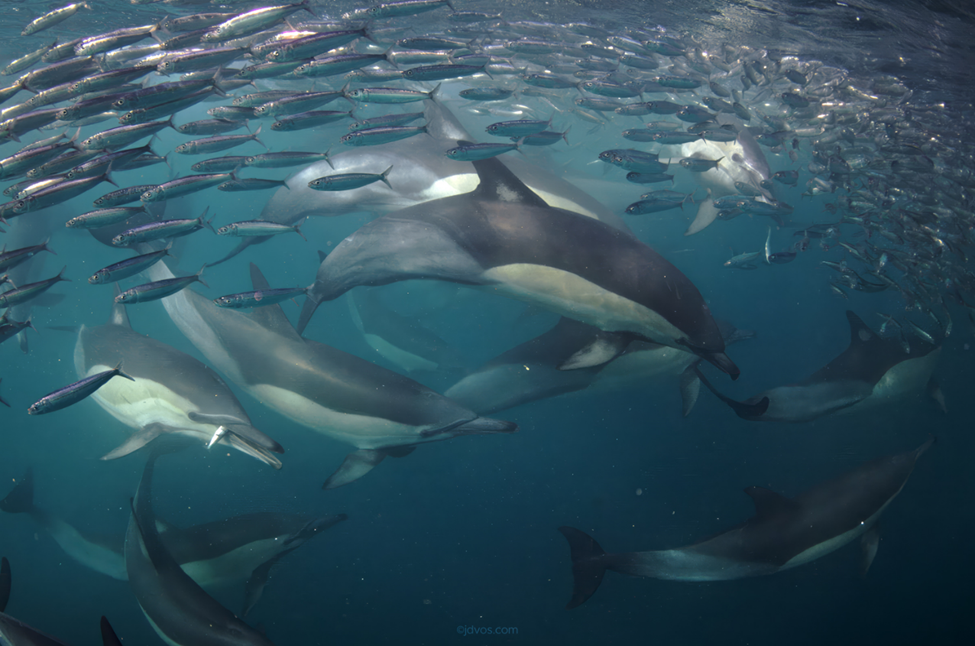
Common Dolphins at the Sardine Run in South Africa
Common dolphins at the Sardine Run in South Africa, Jacques de Vos
Diet and Feeding Behaviour
Common dolphins in Gansbaai, South Africa feeding behaviour’s may differ from other common dolphins that reside in other parts of the word. They are active predators that feed predominantly on small schooling fish and squid. In South African waters, important prey can include species such as sardines and anchovies.
Rather than chewing their food, dolphins use their conical teeth to catch and secure slippery prey before swallowing it. Hunting together can also help dolphins exploit large schools of fish.
Their feeding ecology connects common dolphins with one of South Africa’s most spectacular marine wildlife events — the Sardine Run.
During the South African winter, huge shoals of sardines move along sections of the country’s coastline. These concentrations of fish can attract an extraordinary variety of predators, including dolphins, sharks, whales, Cape fur seals and seabirds.
Common dolphins can gather in large numbers around these shoals, making them an important predator within this remarkable marine event.
Conservation Status
Globally, the Common Dolphin (Delphinus delphis) is currently assessed as Least Concern on the IUCN Red List of Threatened Species.
However, a global conservation category does not mean that every population faces the same pressures. Some regional populations may be more vulnerable, and local conditions can differ considerably.
Common dolphins can be affected by human activities including accidental capture in fishing gear, entanglement, pollution, disturbance, changes to marine habitats and reductions in available prey.
In South Africa, dolphins are protected marine animals. Protecting healthy coastal ecosystems and the food resources on which dolphins depend remains important for their long-term conservation.




Leave A Comment
You must be logged in to post a comment.